
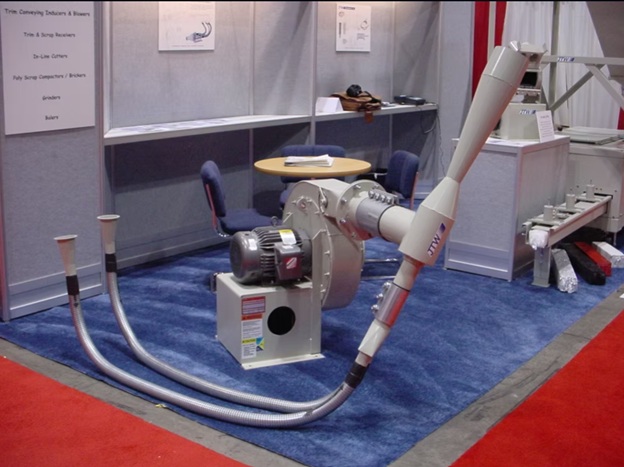

Film, foam, and sheet extrusion lines generate continuous trim. Operators often focus on die settings, temperature stability, and line speed while overlooking scrap movement. Trim does not behave like incidental waste. It moves as a parallel material stream that requires control. When that stream lacks structure, efficiency declines even if the extruder performs correctly.
Automated scrap conveying removes trim at source, stabilizes airflow, and routes scrap directly to downstream plastic recycling equipment. In high-output extrusion environments, scrap flow influences uptime, labor allocation, safety exposure, and recovery value.
Line efficiency depends on how cleanly trim leaves the production.
Scrap Generation Across Film, Foam, and Sheet Lines
Scrap characteristics vary by process, and conveying design must reflect those differences.
Film Extrusion
Film lines produce continuous edge trim with low mass and high surface area. Lightweight trim responds quickly to airflow variation and static buildup. Inconsistent suction at pickup points leads to wrapping near rollers or accumulation around knives. Controlled air velocity maintains steady removal.
Foam Extrusion
Foam trim carries low density and high volume. It compresses easily and behaves unpredictably in turbulent air. Weak suction causes accumulation; excessive turbulence creates duct blockages. Stable vacuum strength and smooth pressure transition maintain consistent transport toward recovery systems.
Sheet Extrusion
Sheet trim carries higher density and rigidity. Long routing distances and larger scrap segments often require mechanical size reduction before transport. Cutter-blower systems support this behavior and maintain stable movement across extended plant layouts.
Scrap behavior determines conveying architecture. Applying identical routing logic to different materials creates repeated inefficiency.
Where Manual Scrap Handling Limits Line Efficiency
Manual scrap handling introduces friction that compounds across shifts. Operators pause lines to clear trim. Forklift drivers exchange bins. Scrap accumulates near pickup points and spreads across the floor space.
Throughput Impact in Practical Terms
A modest two-minute interruption per hour results in:
- Sixteen minutes per shift
- Over one hour per week
- More than sixty hours annually per line
Multiple lines amplify this loss.
Key Operational Friction Points
Manual handling creates:
- Repeated micro-stoppages
- Inconsistent feed to the downstream plastic recycling equipment
- Forklift congestion near active lines
- Scrap contamination from floor debris
- Variable density entering compaction systems
Manual vs Automated Scrap Handling
| Factor | Manual Handling | Automated Scrap Conveying |
| Line interruptions | Frequent | Continuous removal |
| Labor exposure | High | Reduced |
| Scrap consistency | Variable | Controlled stream |
| Downstream feed | Irregular | Stable |
| Floor congestion | Common | Minimal |
Automated scrap conveying converts reactive cleanup into engineered material routing.
Engineering Principles Behind Automated Scrap Conveying
Automated systems rely on controlled airflow and stable discharge.
Venturi-Induced Systems
Venturi systems generate a vacuum at trim pickup using a blower-driven pressure differential. Scrap enters a negative pressure zone and transitions into positive pressure discharge through ducting.
Operational characteristics:
- Moderate conveying distances
- Lower horsepower demand
- Stable transport for film and foam trim
- Multi-line pickup compatibility
Venturi configurations serve plants requiring efficient Conveyors for scrap handling without mechanical pre-cutting.
Cutter-Blower Systems
Cutter-blower systems reduce scrap dimensions mechanically before pneumatic transport. Trim size reduction improves stability across long routing distances and high-volume movement.
Applications include:
- Sheet extrusion
- High-output film lines
- Plant-wide routing
- Denser trim segments
System Selection Criteria
When selecting system type, evaluate:
- Scrap density and rigidity
- Required conveying distance
- Volume per hour
- Number of pickup points
- Integration with downstream equipment
Correct selection prevents blockage, maintains airflow stability, and supports consistent routing.
Scrap Quality and Downstream Performance
Scrap cleanliness influences recovery value and system stability. Manual handling exposes trim to floor debris and moisture. Automated routing encloses scrap from pickup to the receiver.
Stable conveying improves:
- Material recovery value
- Feed consistency to plastic recycling equipment.
- Bale or block uniformity
- Processing stability
Clean trim maintains predictable compaction performance and reduces variability.
How Automated Conveying Improves Foam Recycling Machine Performance
Foam recycling machine performance depends on steady input density and volume. Manual loading introduces inconsistency through batch feeding and density variation.
Automated scrap conveying stabilizes feed characteristics and improves performance.
Performance Gains From Stable Upstream Feed
- Balanced motor load
- Uniform output density
- Reduced mechanical stress
- Improved throughput predictability
- Stable compaction pressure
Consistent upstream routing improves foam recycling machine output uniformity and reduces operational fluctuation.
Financial Impact Beyond Labor Reduction
Operational stability creates measurable financial return.
Labor Allocation
Manual trim handling consumes operator time. Automation reduces direct scrap handling and stabilizes labor planning.
Downtime Stabilization
Micro-stoppages accumulate across shifts. Automation removes repetitive interruption cycles.
Forklift Traffic Reduction
Bin exchange increases congestion and risk exposure. Automated routing reduces floor traffic and improves housekeeping discipline.
Scrap Monetization
Clean, consistent trim commands stronger resale pricing and supports stable downstream processing.
Direct Cost Drivers Affected by Automation
- Labor hours per shift
- Downtime exposure
- Scrap resale pricing
- Container utilization
- Forklift operating hours
ROI Framework
| Cost Category | Manual Handling | Automated Conveying |
| Labor allocation | Elevated | Reduced |
| Downtime variability | High | Stable |
| Scrap value | Lower | Higher |
| Haul frequency | Frequent | Optimized |
Facilities evaluating plastic recycling equipment for sale often focus on densification. Stable conveying strengthens the performance of all plastic recycling equipment installed downstream.
When Facilities Evaluate Plastic Recycling Equipment for Sale
Capital review typically begins when scrap volume increases beyond manual handling capacity.
Common triggers include:
- Scrap exceeding ten percent of the throughput
- Multi-line coordination challenges
- Frequent bin replacement
- Planned integration with densification
Reviewing plastic recycling equipment for sale without evaluating upstream routing creates an imbalance. Conveying forms a foundation for stable integration.
Integrating Conveyors for Scrap Handling Into Plant Strategy
Modern extrusion plants treat scrap routing as infrastructure. Continuous trim receivers, cyclone separation units, and PLC-compatible controls integrate into plant systems.
Conveyors for scrap handling connect pickup points directly to compactors, balers, or densifiers without manual intervention. Facilities that review plastic recycling equipment for sale benefit from integrated design rather than isolated upgrades.
JTW International is a U.S.-based manufacturer that designs conveying systems engineered for extrusion and converting environments, integrating trim removal directly with densification and recycling equipment.
Facilities reviewing upgrades benefit from examining industrial trim conveying system specifications before capital allocation to ensure airflow capacity and routing distances align with plant layout.
Indicators That Scrap Conveying Requires Upgrade
Automation becomes an operational priority when:
- Scrap interrupts production more than twice per shift
- Forklift congestion increases near the lines.
- Scrap contamination reduces recovery pricing.
- Integration with a foam recycling machine is planned.
- Output expansion increases trim volume.
At this stage, manual routing limits efficiency and growth.
Frequently Asked Questions
How far can scrap be conveyed effectively?
Distance depends on airflow capacity, duct diameter, and material density. Venturi systems support moderate routing, while cutter-blower configurations handle longer distances.
Does automated conveying improve scrap resale value?
Yes. Enclosed routing reduces contamination and preserves material quality.
Can Conveying integrate directly with a foam recycling machine?
Yes. Continuous trim receivers deliver stable feed and improve compaction consistency.
What scrap rate justifies automation?
Facilities exceeding ten percent scrap relative to throughput often observe measurable gains.
Does system selection differ between film and sheet lines?
Yes. Film and foam align with venturi configurations. Sheet trim often benefits from cutter-assisted transport.
Conclusion
Extrusion efficiency reflects the entire material ecosystem. Scrap movement influences uptime, labor stability, resale pricing, and downstream processing performance. Automated scrap conveying transforms uncontrolled trim into engineered material flow.
Plants that treat scrap routing as infrastructure protect throughput, strengthen integration with plastic recycling equipment, and position operations for sustained growth.
