
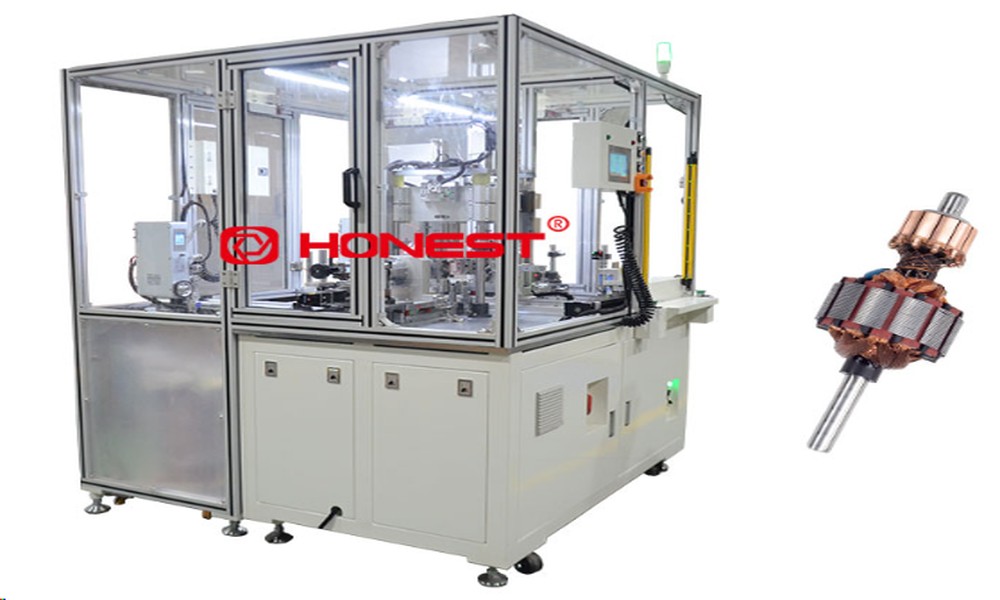

The demand for electric motors continues to grow rapidly across industries such as automotive, home appliances, industrial automation, and renewable energy. As production requirements increase, manufacturers are under pressure to deliver higher output while maintaining consistent quality and reducing operational costs. One of the key technologies supporting this transformation is the armature winding machine, particularly the automatic armature winding machine, which has significantly improved manufacturing efficiency and precision.
By automating the winding process, manufacturers can produce high-quality armatures at scale while reducing human error, labor dependency, and production time. This advancement plays a critical role in modern motor manufacturing, where speed and accuracy are essential.
Understanding Armature Winding in Electric Motors
Armature winding is a crucial part of electric motor construction. It involves placing copper wire into the armature slots to create electromagnetic fields that enable motor operation. The quality of the winding directly affects motor efficiency, torque, and overall performance.
Traditionally, armature winding was performed manually or with semi-automatic machines. While these methods were effective in earlier production environments, they often resulted in inconsistencies, slower production rates, and higher labor costs.
The introduction of the automatic armature winding machine has transformed this process by enabling fully automated, precise, and repeatable winding operations.
How an Automatic Armature Winding Machine Works
An automatic armature winding machine is designed to handle multiple stages of the winding process with minimal human intervention. The process typically includes wire feeding, tension control, slot positioning, winding, and cutting.
The machine uses advanced servo systems to ensure accurate wire placement within the armature slots. It carefully controls wire tension to prevent damage and maintain uniform winding quality.
Once the winding process is complete, the machine automatically cuts and secures the wire, preparing the armature for the next stage of motor assembly.
This automation ensures consistent quality across large production volumes, making it ideal for industrial-scale manufacturing.
Advantages of Automatic Armature Winding Machines
The use of automatic armature winding machines offers several important benefits for manufacturers.
Increased Production Speed
Automation significantly reduces the time required to wind each armature. Machines can operate continuously at high speed, enabling manufacturers to meet growing production demands efficiently.
Improved Winding Accuracy
Precise servo control ensures that each wire is placed accurately within the armature slots. This improves motor performance and reduces the risk of defects.
Reduced Labor Costs
By automating the winding process, manufacturers can reduce reliance on manual labor. This leads to lower operational costs and improved efficiency.
Consistent Product Quality
Automation eliminates variations caused by human error, ensuring that every armature meets the same quality standards.
Enhanced Production Stability
Automatic systems are designed for continuous operation, improving overall production stability and reducing downtime.
Importance in Modern Motor Manufacturing
The armature winding machine plays a vital role in the production of electric motors used in various applications. From household appliances to industrial machinery and electric vehicles, high-quality armatures are essential for efficient motor performance.
The automatic armature winding machine ensures that manufacturers can produce these components at scale without compromising quality. This is especially important in industries where precision and reliability are critical.
As global demand for electric motors continues to rise, automation in winding processes has become a necessity rather than an option.
Role in Electric Vehicle Production
Electric vehicles rely heavily on efficient motor systems. Armature winding quality directly impacts motor efficiency, power output, and energy consumption.
Automatic armature winding machines help EV manufacturers achieve consistent winding quality, which contributes to better motor performance and longer vehicle range.
As the EV industry expands, demand for advanced winding automation technology is expected to increase significantly.
Integration with Smart Manufacturing Systems
Modern automatic armature winding machines are increasingly integrated into smart manufacturing environments. These machines can communicate with other production systems, allowing real-time monitoring and data analysis.
This integration supports predictive maintenance, process optimization, and improved production planning. Manufacturers can identify inefficiencies early and make data-driven decisions to enhance productivity.
Smart factory integration is becoming a standard requirement in advanced motor production facilities.
Challenges in Armature Winding Automation
Despite its advantages, automation in armature winding also presents certain challenges. High initial investment costs can be a barrier for smaller manufacturers.
Additionally, machine setup and calibration require skilled technicians to ensure optimal performance. Maintenance and technical support are also important for long-term reliability.
However, these challenges are often outweighed by long-term benefits such as increased productivity, reduced labor costs, and improved product quality.
Future Trends in Armature Winding Technology
The future of armature winding machines is closely linked to advancements in automation, robotics, and artificial intelligence. Future machines are expected to become more intelligent, with self-adjusting capabilities and improved error detection systems.
AI-based monitoring will help optimize winding parameters in real time, further improving efficiency and reducing waste. Robotics integration will also enable fully automated motor production lines with minimal human intervention.
As manufacturing continues to evolve, automatic armature winding machines will play an even more important role in industrial production systems.
Conclusion
The automatic armature winding machine is a critical innovation in modern electric motor manufacturing. By automating the winding process, it enhances production efficiency, improves accuracy, reduces costs, and ensures consistent quality.
As industries such as electric vehicles, industrial automation, and consumer electronics continue to grow, the demand for high-performance motor components will increase. Automation in armature winding will remain essential for meeting these demands efficiently.
With continuous advancements in technology, automatic armature winding machines will continue to evolve, supporting faster, smarter, and more efficient motor production in the future.
